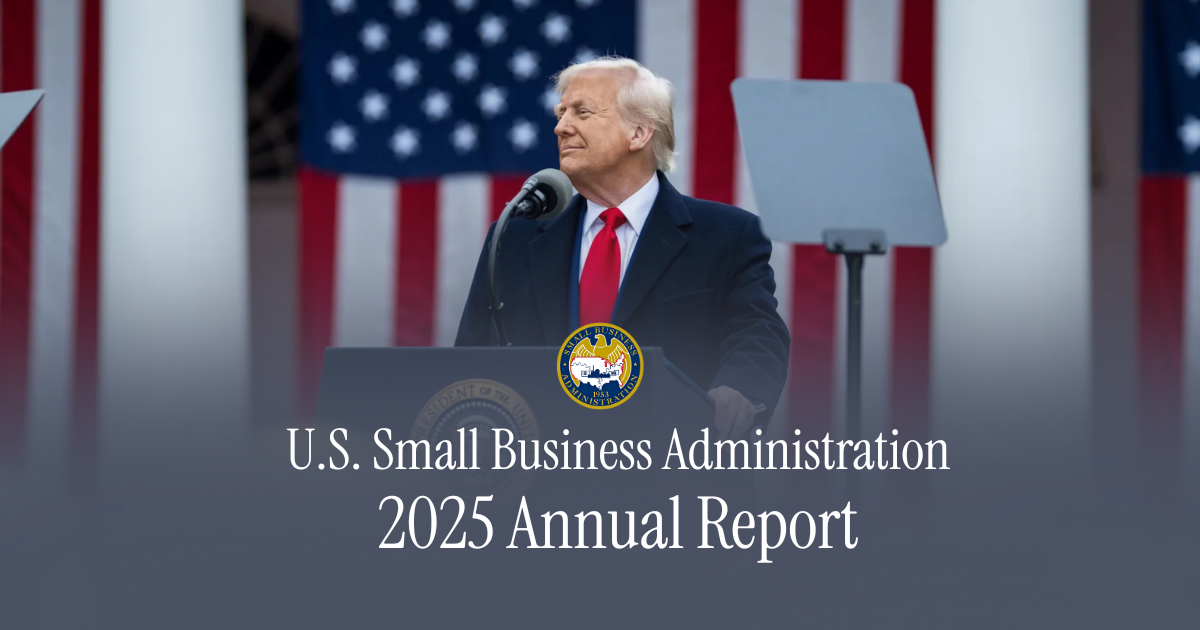
The U.S. Small Business Administration has released its 2025 Annual Report outlining record levels of small business lending, expanded oversight, and significant changes to how federal contracting and certification programs operate. Today, the agency issued clarifying guidance on the 8(a) Business Development Program, reinforcing that race-based presumptions of eligibility are not permitted and that enforcement and compliance standards have tightened.
Taken together, these updates paint a clear picture of the current small business environment:
capital is still flowing, but expectations around documentation, eligibility, and compliance are higher than ever.
For Black-owned businesses, this moment is not about disappearing opportunities. It is about understanding how the rules have changed and how to position for success within them.
Record Capital, With Higher Standards
According to the SBA’s report, 2025 was a historic year for capital access:
- Over $45 billion in SBA-backed 7(a) and 504 loans were approved
- More than 85,000 small businesses received financing
- The SBA’s investment programs continued to mobilize billions in private capital
- Disaster lending remained a major support channel for recovering businesses
This matters. Access to capital remains one of the biggest barriers for Black-owned businesses, and the scale of funding has not disappeared.
What has changed is the environment around that access.
Lenders and agencies are placing greater emphasis on:
- Verifiable financial records
- Clear ownership and control structures
- Operational history and compliance readiness
Funding is available, but it increasingly favors businesses that are organized, documented, and growth-ready.
Manufacturing and “Real Economy” Businesses Are a Priority
The SBA report highlights a renewed federal focus on domestic manufacturing, supply chains, and job creation through initiatives such as the Made in America Manufacturing Initiative.
For Black-owned businesses, this creates opportunity in areas like:
- Manufacturing and production
- Logistics and distribution
- Construction and trades
- Food production and processing
However, these opportunities are tied to scale, compliance, and execution. Businesses positioned to meet contracts, deliver consistently, and pass audits will be the ones that benefit most.
Small Business Confidence Is Up, But Not Evenly
The SBA reports that small business confidence is above its long-term historical average, driven by economic stabilization, wage growth, and private-sector investment.
That optimism is real, but it is not evenly distributed.
Businesses with:
- Clean books
- Professional operations
- Clear growth strategies
are experiencing that confidence very differently than those still operating informally or without financial clarity.
This gap is important. Confidence increasingly follows preparedness.
Major Shift in the 8(a) Business Development Program
One of the most significant changes affecting Black-owned businesses comes from updates to the SBA’s 8(a) Business Development Program and how it is being administered in late 2025 and early 2026.
The SBA has issued new guidance clarifying that eligibility for the 8(a) Program must be based on documented economic and social disadvantage, not on race alone. The agency has stated that race-based presumptions of disadvantage are no longer permitted and that prior guidance encouraging narrative-based claims of racial discrimination has been removed. The intention, according to the SBA, is for the program to operate in a race-neutral, documentation-driven manner consistent with constitutional requirements.
Alongside this guidance, the SBA has significantly intensified oversight of the 8(a) Program. In late 2025, the SBA required all 8(a) participants — more than 4,300 firms — to submit multiple years of financial records as part of a comprehensive effort to uncover fraud, waste, and abuse. Firms that fail to provide the requested documentation risk having their eligibility for continued participation reviewed or suspended.
This escalation in enforcement includes the first full-scale audit of 8(a) contracting activity, with federal agencies like the Department of Defense and the Department of the Treasury conducting parallel audits of 8(a) contracts. Experts and industry observers note that heightened scrutiny could affect how the program operates and how contracting decisions are made going forward.
It is important to be clear about what this means in practice:
- Race is no longer the sole determinant of eligibility for the 8(a) Program; documentation of economic and social disadvantage is required.
- Program requirements and oversight are stricter, and many participants are being asked to produce extensive records.
- Federal scrutiny of the program has intensified and may affect how 8(a) contracts are awarded going forward.
This does not close the 8(a) Program to Black-owned businesses. The program remains open and can still be a valuable pathway to federal contracts and business development.
It does mean that the standards for participation are different than in the past and that businesses must understand and meet the documentation and compliance expectations currently required.
Why This Matters for Black-Owned Businesses
The changes outlined in the SBA’s 2025 report and recent 8(a) guidance raise the bar on how businesses are reviewed, funded, and approved. For Black-owned businesses, this moment is about being informed, prepared, and positioned to move forward with clarity.
Opportunities have not disappeared, but the path to them now requires stronger documentation, clearer financials, and greater operational readiness. Businesses that have these fundamentals in place are better equipped to navigate reviews, audits, and competitive funding or contracting processes.
This is not about meeting someone else’s standard. It is about protecting our businesses, expanding our options, and building operations that can stand up in any room, with any lender, agency, or partner.
When our businesses are prepared, we are harder to overlook, harder to question, and better positioned to grow on our own terms. Readiness is not just compliance. It is leverage.